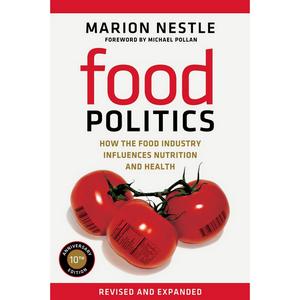
Food Politics: How the Food Industry Influences Nutrition and Health
by Marion Nestle
We all witness, in advertising and on supermarket shelves, the fierce competition for our food dollars. In this engrossing exposé, Marion Nestle goes behind the scenes to reveal how the competition really works and how it affects our health. The abundance of food in the United States–enough calories to meet the needs of every man, woman, and child twice over–has a downside. Our over-efficient food industry must do everything possible to persuade people to eat more–more food, more often, and in larger portions–no matter what it does to waistlines or well-being.
Like manufacturing cigarettes or building weapons, making food is big business. Food companies in 2000 generated nearly $900 billion in sales. They have stakeholders to please, shareholders to satisfy, and government regulations to deal with. It is nevertheless shocking to learn precisely how food companies lobby officials, co-opt experts, and expand sales by marketing to children, members of minority groups, and people in developing countries. We learn that the food industry plays politics as well as or better than other industries, not least because so much of its activity takes place outside the public view.
Editor of the 1988 Surgeon General’s Report on Nutrition and Health, Nestle is uniquely qualified to lead us through the maze of food industry interests and influences. She vividly illustrates food politics in action: watered-down government dietary advice, schools pushing soft drinks, diet supplements promoted as if they were First Amendment rights. When it comes to the mass production and consumption of food, strategic decisions are driven by economics–not science, not common sense, and certainly not health. No wonder most of us are thoroughly confused about what to eat to stay healthy.
An accessible and balanced account, Food Politics will forever change the way we respond to food industry marketing practices. By explaining how much the food industry influences government nutrition policies and how cleverly it links its interests to those of nutrition experts, this path-breaking book helps us understand more clearly than ever before what we eat and why.
Marion Nestle
Marion Nestle is Paulette Goddard Professor in the Department of Nutrition, Food Studies, and Public Health at New York University, which she chaired from 1988-2003. She also holds appointments as Professor of Sociology at NYU and Visiting Professor of Nutritional Sciences at Cornell. Her degrees include a Ph.D. in molecular biology and an M.P.H. in public health nutrition, both from the University of California, Berkeley. She has held faculty positions at Brandeis University and the UCSF School of Medicine. From 1986-88, she was senior nutrition policy advisor in the Department of Health and Human Services and managing editor of the 1988 Surgeon General’s Report on Nutrition and Health. Her research examines scientific, economic, and social influences on food choice.
She is the author of three prize-winning books: “Food Politics: How the Food Industry Influences Nutrition and Health” (2002, revised edition, 2007), “Safe Food: The Politics of Food Safety” (2003, revised edition, 2010), and “What to Eat” (2006). “Pet Food Politics: The Chihuahua in the Coal Mine” was published in September 2008 and in paperback in 2010. Her book with Dr. Malden Nesheim, “Feed Your Pet Right,” was published by Free Press/Simon & Schuster in May 2010. “Why Calories Count: From Science to Politics,” also co-authored with Dr. Nesheim, is scheduled for publication in March 2012.
She writes a monthly Food Matters column for the San Francisco Chronicle, and blogs daily (almost) at http://www.foodpolitics.com. She also twitters @marionnestle.
GET THE COMPLETE PDF EBOOK HERE
GET THE COMPLETE MP3 AUDIOBOOK HERE


 VolumesOfValue