For a New Liberty: The Libertarian Manifesto
by Murray N Rothbard
In For a New Liberty: The Libertarian Manifesto, Rothbard proposes a once-and-for-all escape from the two major political parties, the ideologies they embrace, and their central plans for using state power against people.
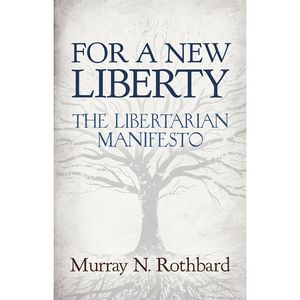
Libertarianism is Rothbard’s radical alternative that says state power is unworkable and immoral and ought to be curbed and finally overthrown.To make his case, Rothbard deploys his entire system of thought: natural law, natural rights, Austrian economics, American history, the theory of the state, and more.It is relentless, scientific, analytical, and morally energetic — a book that makes an overwhelming case. Indeed, it gave an entire movement its intellectual consciousness and earned Rothbard the titles “Mr. Libertarian” and “The State’s Greatest Living Enemy.”Society without the nation-state? Rothbard shows that this is the way for peace, prosperity, security, and freedom for all. In the entire history of libertarian ideas, no book has more successfully combined ideological rigor, theoretical exposition, political rhetoric, historical illustration, and strategic acumen. Rothbard poured a lifetime of research and all his intellectual energy into this project and he succeeded in writing a classic.The book is the result of the only contract Rothbard ever received from a mainstream commercial publisher. He was asked to sum up the whole of the libertarian creed. Looking at the original manuscript, which was nearly complete after its first draft, it seems that it was a nearly effortless joy for him to write. It is seamless, unrelenting, and full of life.He cut no corners and pulled no punches. It appeared in 1973 and created a whole movement that set out to crush the political monopoly.In subject after subject, this book is informative, bracing, and challenging. It also features the characteristically clear writing style for which Rothbard is famous, which stemmed from his organized thinking and passionate drive to teach and change the world.The book begins with American history to show that the revolution of 1776 was the most libertarian of any in history. The pastors, pamphleteers, and statesmen who led it held that the state has no rights that the people themselves do not possess. They demanded full liberty, not some truncated version that existed in the old world. In this discussion, the reader comes to appreciate the founders of the United States of America as never before.Rothbard then sets out to rekindle that fire, first through a discussion of the philosophy and ethics of freedom. The central axiom: no man or group of men may aggress against the person and property of anyone else. He justifies the axiom on the basis of natural rights. It is an axiom that has few opponents, until Rothbard spells out its implications: taxation is theft, conscription is slavery, and war is mass murder, among many other points.Bracing indeed! But the state is the primary violator of this simple axiom. It presumes the right to rob and kill while purporting to protect us from robbing and killing. Thus follows a full theory of the state, how it gains and maintains controls over the population (but not through a “social contract”!), the various failed methods for keeping it in check (not even constitutions work!), its operations and tendencies to work its evil (it never has enough power), and how intellectuals become co-opted by the forces of state power.The book is still regarded as “dangerous” precisely because, once the exposure to Rothbardianism takes place, no other book on politics, economics, history, or sociology can be read the same way again.
Murray N. Rothbard
Murray Newton Rothbard (/ˈmʌri ˈrɑːθbɑːrd/; March 2, 1926 – January 7, 1995) was an American heterodox economist of the Austrian School, a revisionist historian, and a political theorist(pp11, 286, 380) whose writings and personal influence played a seminal role in the development of modern libertarianism. Rothbard was the founder and leading theoretician of anarcho-capitalism, a staunch advocate of historical revisionism, and a central figure in the twentieth-century American libertarian movement. He wrote over twenty books on political theory, revisionist history, economics, and other subjects. Rothbard asserted that all services provided by the “monopoly system of the corporate state” could be provided more efficiently by the private sector and wrote that the state is “the organization of robbery systematized and writ large.” He called fractional reserve banking a form of fraud and opposed central banking. He categorically opposed all military, political, and economic interventionism in the affairs of other nations.(pp4–5, 129) According to his protégé Hans-Hermann Hoppe, “There would be no anarcho-capitalist movement to speak of without Rothbard.”
Rothbard was a heterodox economist. Economist Jeff Herbener, who calls Rothbard his friend and “intellectual mentor”, wrote that Rothbard received “only ostracism” from mainstream academia. Rothbard rejected mainstream economic methodologies and instead embraced the praxeology of his most important intellectual precursor, Ludwig von Mises. To promote his economic and political ideas, Rothbard joined Llewellyn H. “Lew” Rockwell, Jr. and Burton Blumert in 1982 to establish the Ludwig von Mises Institute in Alabama.
GET THE COMPLETE PDF EBOOK HERE
GET THE COMPLETE MP3 AUDIOBOOK HERE


 VolumesOfValue