Propaganda
by Edward Bernays
VolumesOfValue presents
“A select list of nonfiction books to expand your horizon!” — Enri Tudor, CEO
About the Book
“The conscious and intelligent manipulation of the organized habits and opinions of the masses is an important element in democratic society. Those who manipulate this unseen mechanism of society constitute an invisible government which is the true ruling power of our country.”—Edward Bernays
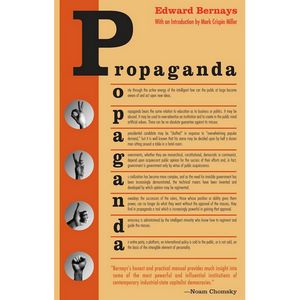
2024 Reprint of the 1928 Edition. Propaganda, an influential book written by Bernays in 1928, incorporated the literature from social science and psychological manipulation into an examination of the techniques of public communication. Bernays wrote the book in response to the success of some of his earlier works such as Crystallizing Public Opinion (1923) and A Public Relations Counsel (1927). Propaganda explored the psychology behind manipulating masses and the ability to use symbolic action and propaganda to influence politics, consumer choices and corporate image, which we now call “branding”. Walter Lippmann was Bernays’ unacknowledged American mentor and his work The Phantom Public greatly influenced the ideas expressed in Propaganda a year later. The work propelled Bernays into media historians’ view of him as the “father of public relations.” Bernay’s manual of mass manipulation provides a detailed examination of how public discourse and opinion are shaped and controlled in politics, business, art, education, and science. In a world dominated by political spin and media manipulation, Propaganda is an essential read for all who wish to understand how power is used by the ruling elite of our society. The nephew of Sigmund Freud, Edward Bernays (1891-1995) pioneered the scientific technique of shaping and manipulating public opinion, which he called “engineering of consent.'” During World War I, he was an integral part–along with Walter Lippmann–of the U.S. Committee on Public Information (CPI), a powerful propaganda machine that advertised and sold the war to the American people as one that would “Make the World Safe for Democracy.” The marketing strategies for all future wars would be based on the CPI model. Over the next half century, Bernays, combining the techniques he had learned in the CPI with the ideas of Lippmann and Freud, fashioned a career as an outspoken proponent of the engineering of consent for political and corporate influence of the population, earning the moniker “father of public relations.” Among his powerful clients were President Calvin Coolidge, Procter & Gamble, CBS, the American Tobacco Company, and General Electric, and the United Fruit Company.
About the Author
A seminal and controversial figure in the history of political thought and public relations, Edward Bernays (1891–1995), pioneered the scientific technique of shaping and manipulating public opinion, which he famously dubbed “engineering of consent.” During World War I, he was an integral part of the U.S. Committee on Public Information (CPI), a powerful propaganda apparatus that was mobilized to package, advertise and sell the war to the American people as one that would “Make the World Safe for Democracy.” The CPI would become the blueprint in which marketing strategies for future wars would be based upon.
Bernays applied the techniques he had learned in the CPI and, incorporating some of the ideas of Walter Lipmann, as well as his uncle, Sigmund Freud, became an outspoken proponent of propaganda as a tool for democratic and corporate manipulation of the population. His 1928 bombshell Propaganda lays out his eerily prescient vision for using propaganda to regiment the collective mind in a variety of areas, including government, politics, art, science and education. To read this book today is to frightfully comprehend what our contemporary institutions of government and business have become in regards to organized manipulation of the masses.
VolumesOfValue offers
book recommendations, book reviews, books on history, biography, economics, memoir, nature, philosophy, religion, science, nonfiction, book downloads, free books, books-for-a-buck, volumesofvalue.gumroad.com


 VolumesOfValue