What Has Government Done to Our Money
by Murray N. Rothbard
VolumesOfValue volumesofvalue.gumroad.com
“A select list of nonfiction books to expand your horizon!” — Enri Tudor, CEO
About the Book
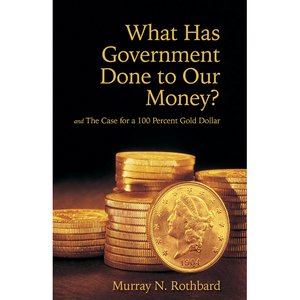
When this gem first appeared in 1963, it took the form of a small paperback designed for mass distribution. We’ve conjured up that spirit again with this special edition of Rothbard’s primer on money and government.Innumerable economists, investors, commentators, and authors have learned from this book through the decades. After fifty years, it remains the best book in print on the topic, a real manifesto of sound money.Rothbard boils down the Austrian theory to its essentials. The book also made huge theoretical advances. Rothbard was the first to prove that the government, and only the government, can destroy money on a mass scale, and he showed exactly how they go about this dirty deed. But just as importantly, it is beautifully written. He tells a thrilling story because he loves the subject so much.The passion that Murray feels for the topic comes through in the prose and transfers to the reader. Readers become excited about the subject, and tell others. Students tell professors. Some, like the great Ron Paul of Texas, have even run for political office after having read it.Rothbard shows precisely how banks create money out of thin air and how the central bank, backed by government power, allows them to get away with it. He shows how exchange rates and interest rates would work in a true free market. When it comes to describing the end of the gold standard, he is not content to describe the big trends. He names names and ferrets out all the interest groups involved.Since Rothbard’s death, scholars have worked to assess his legacy, and many of them agree that this little book is one of his most important. Though it has sometimes been inauspiciously packaged and is surprisingly short, its argument took huge strides toward explaining that it is impossible to understand public affairs in our time without understanding money and its destruction.
About the Author
Murray Newton Rothbard (/ˈmʌri ˈrɑːθbɑːrd/; March 2, 1926 – January 7, 1995) was an American heterodox economist of the Austrian School, a revisionist historian, and a political theorist(pp11, 286, 380) whose writings and personal influence played a seminal role in the development of modern libertarianism. Rothbard was the founder and leading theoretician of anarcho-capitalism, a staunch advocate of historical revisionism, and a central figure in the twentieth-century American libertarian movement. He wrote over twenty books on political theory, revisionist history, economics, and other subjects. Rothbard asserted that all services provided by the “monopoly system of the corporate state” could be provided more efficiently by the private sector and wrote that the state is “the organization of robbery systematized and writ large.” He called fractional reserve banking a form of fraud and opposed central banking. He categorically opposed all military, political, and economic interventionism in the affairs of other nations.(pp4–5, 129) According to his protégé Hans-Hermann Hoppe, “There would be no anarcho-capitalist movement to speak of without Rothbard.”
Rothbard was a heterodox economist. Economist Jeff Herbener, who calls Rothbard his friend and “intellectual mentor”, wrote that Rothbard received “only ostracism” from mainstream academia. Rothbard rejected mainstream economic methodologies and instead embraced the praxeology of his most important intellectual precursor, Ludwig von Mises. To promote his economic and political ideas, Rothbard joined Llewellyn H. “Lew” Rockwell, Jr. and Burton Blumert in 1982 to establish the Ludwig von Mises Institute in Alabama.
VolumesOfValue offers
book recommendations, book reviews, books on history, biography, economics, memoir, nature, philosophy, religion, science, nonfiction, book downloads, free books, books-for-a-buck, volumesofvalue.gumroad.com


 VolumesOfValue